
News
- Press Release
Share


Approximately 40% of people who use AI generation in their work would "continue using it even if it were prohibited."
 Cyber Security Cloud, Inc. (Headquarters: Shinagawa-ku, Tokyo; Representative Director, President and CEO: Toshihiro Koike; hereinafter referred to as "the Company"), a global security manufacturer, conducted the "Generative AI Usage Survey 2026 - The Black Box Nature of Generative AI -" targeting 360 company employees who use generative AI in their work. This time, we will announce the survey results that highlight the lack of transparency in the actual usage of generative AI, with the theme of "The Black Box Nature of Generative AI."
■ Survey Summary
1. 18.9% of people "apply for and share all" AI-generated data used for business purposes with their company.
2. For tasks performed using AI-generated results,it is difficult to explain or reproduce the results in approximately 40% of cases.
3. Even if the use of generated AI is prohibited, approximately 40% will choose to continue using it.
1. 18.9% of people "apply for and share all" AI-generated data used for business purposes with their company.
When asked about the status of reporting to their company regarding the generation AI they use in their work, only 18.9% responded that they "report and share everything." On the other hand, 50.8% responded that they "report and share about half," "report and share only some," or "rarely report and share," revealing that even though one in two people use generation AI, they are not adequately sharing it.
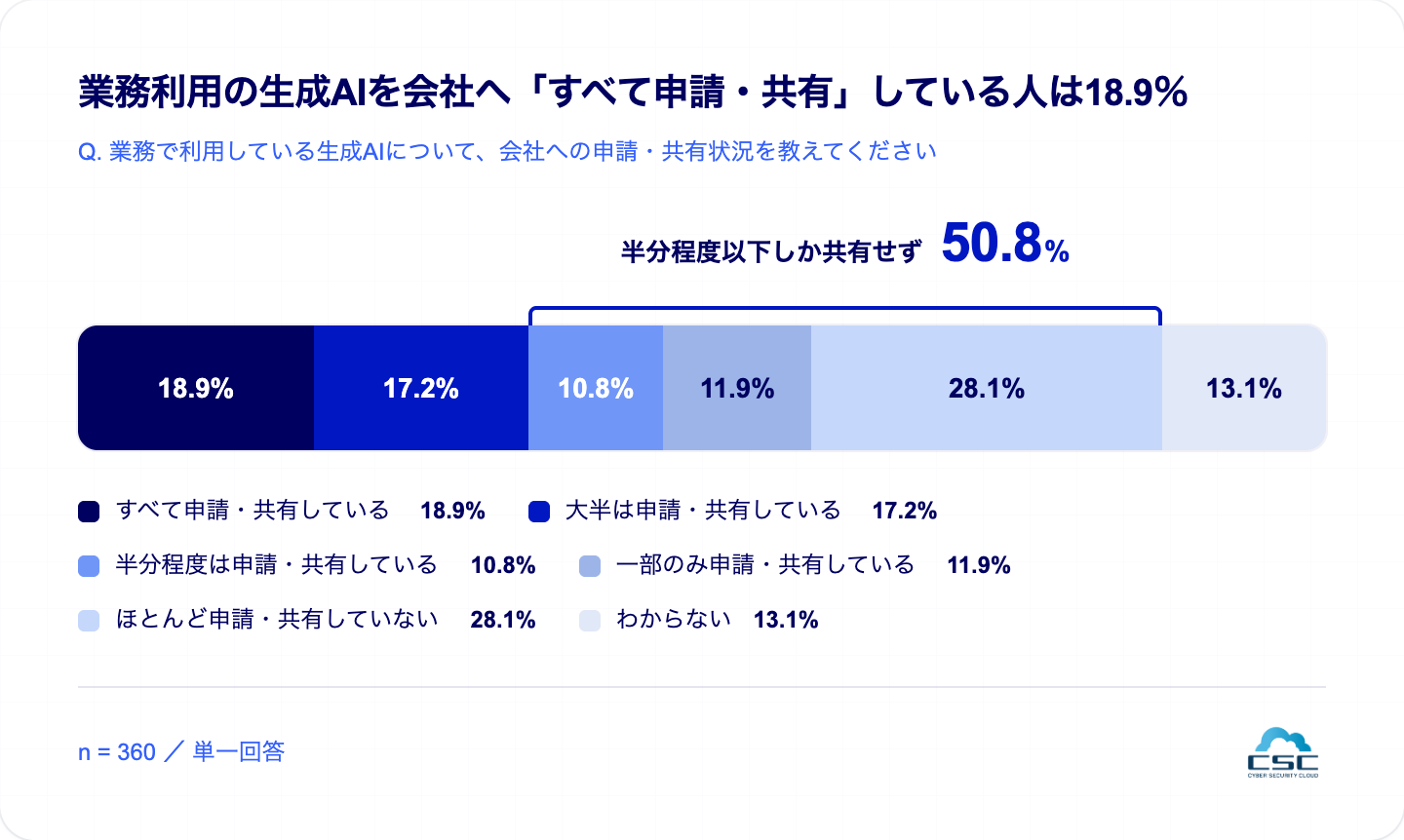
This suggests a possible gap between how companies perceive usage and how it is actually being used.Furthermore, 13.1% of respondents answered "I don't know," indicating potential challenges in the dissemination and implementation of application and sharing rules regarding the use of generation AI.
2. For tasks performed using AI-generated results, it is difficult to explain or reproduce the results in approximately 40% of cases.
Regarding the use of generative AI, when asked, "Do you find it difficult to explain or reproduce tasks performed using generative AI afterward?", 39.7% answered "yes." As theuse of generative AI increases, it appears that even users themselves are finding it increasingly difficult to accurately explain the basis for their decisions ("why they arrived at that result") and how to reproduce the same result ("what steps can be taken").
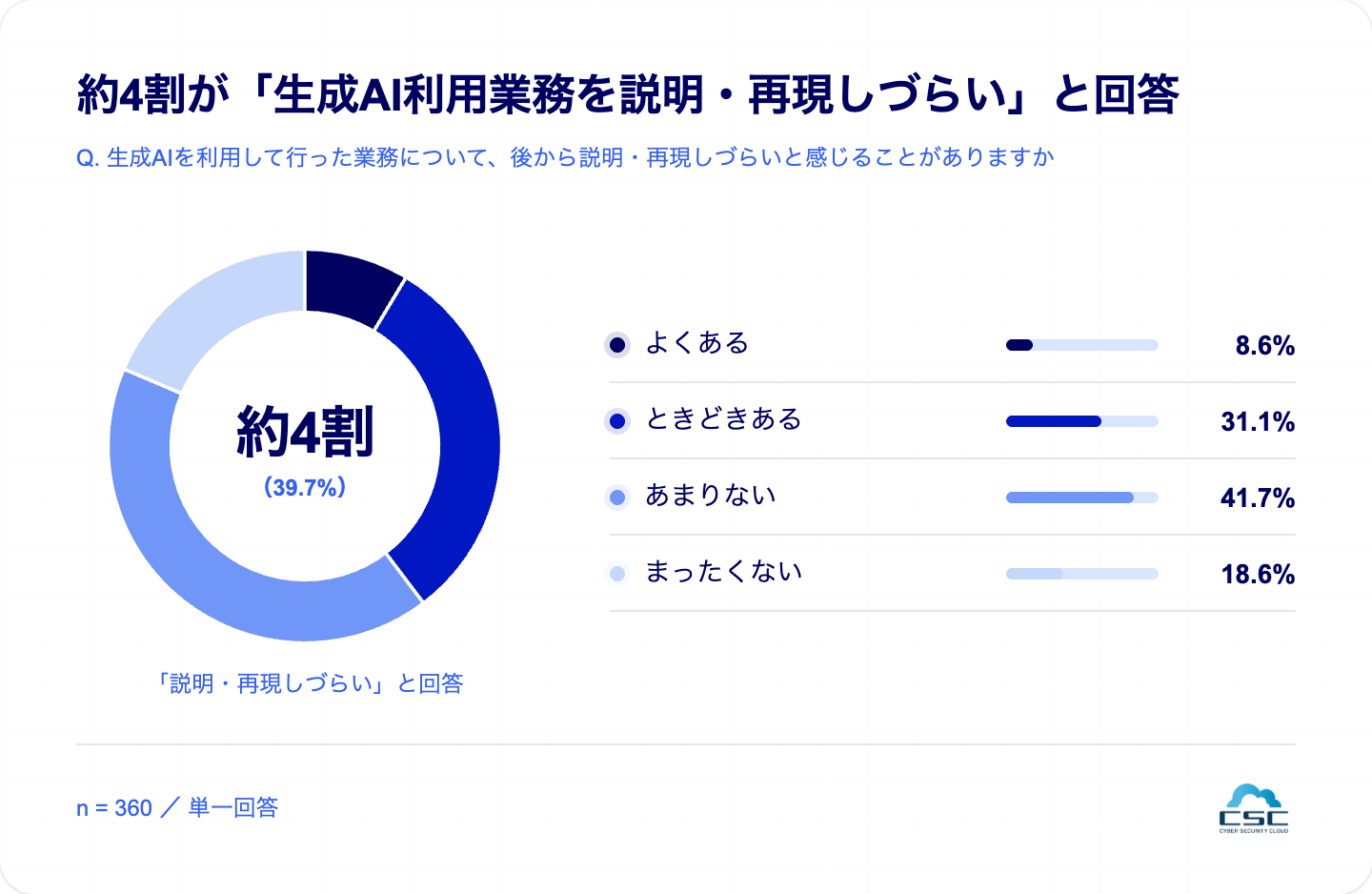
While traditional work processes were often personalized, resulting in situations where "only that person could do it," the increasing use of generational AI is creating new challenges, such as "it's difficult for even the person themselves to explain why they arrived at that result" and "it's difficult to organize the steps to reproduce the same result."
Such situations can make it difficult to hand over tasks, verify deliverables, and investigate the causes of errors. For companies, ensuring transparency and accountability in business processes is becoming a new challenge.
3. Even if the use of generated AI is prohibited, approximately 40% will choose to continue using it.
When asked what they would do if the use of AI generation was prohibited at their workplace, 37.8% indicated their intention to continue using it, with 19.2% saying they would "continue using it personally" and 18.6% saying they would "appeal to the company to allow continued use for the sake of improving work efficiency."In addition, 7.2% said they would "consider other options such as changing jobs or taking on a side job," indicating that the deep integration of AI generation into the workplace has created a gap between the reality on the ground and company rules.
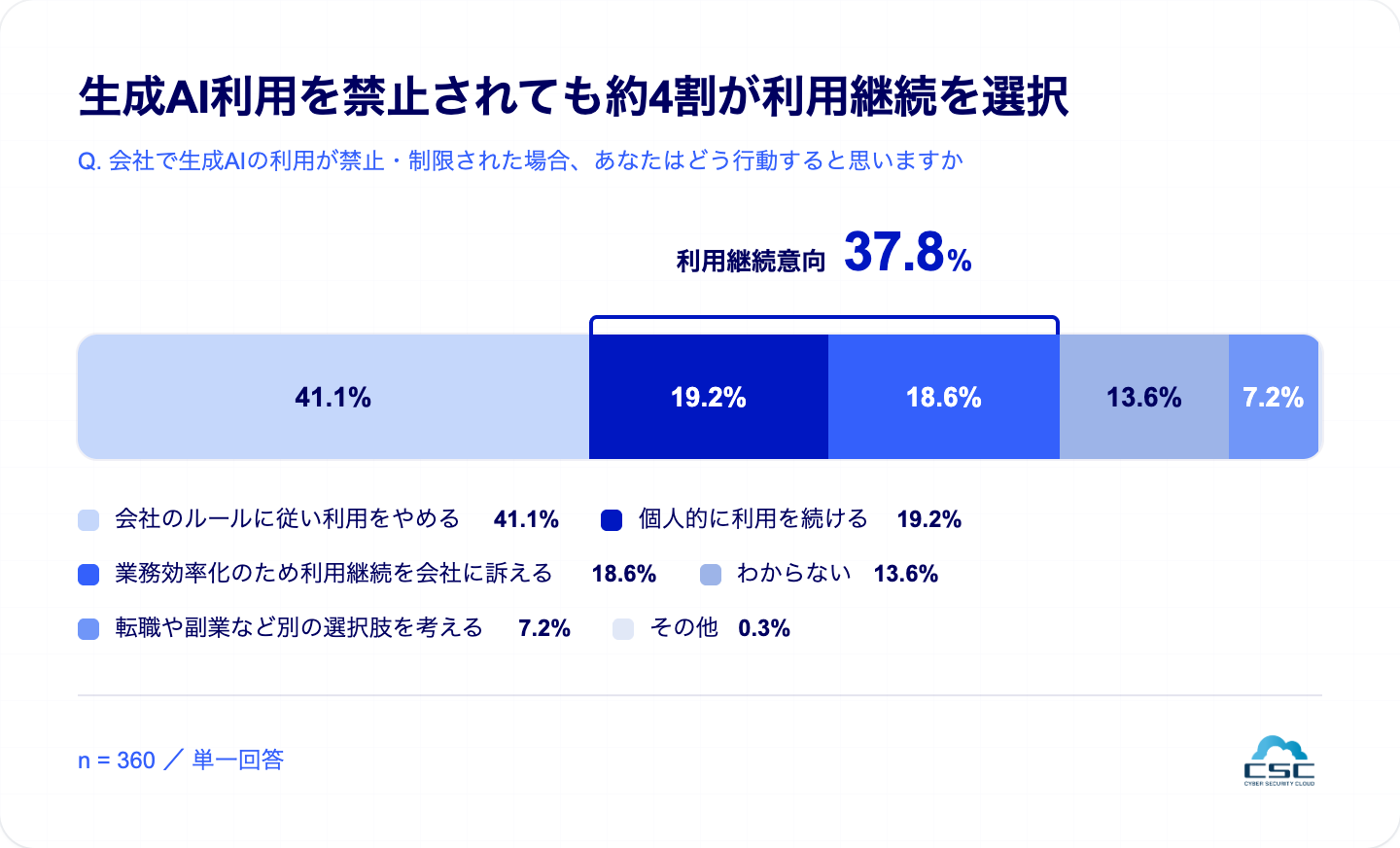
Furthermore, when analyzed by degree of dependence on generative AI, 55.4% of those who answered "I think I'm dependent on generative AI" said they would "continue using it even if it were prohibited." On the other hand, only 24.1% of those who are not dependent said the same, indicating that those who are dependent are about 2.3 times more likely to continue using it than those who are not.
As the use of AI-generated content is becoming an integral part of business operations, the "prohibition will solve the problem" approach is no longer effective. Companies are now required to develop internal regulations and operational systems that prioritize safe and secure use, rather than simply restricting its use across the board.
■Summary
This survey revealed that, with the expansion of generative AI use, there is a growing trend of AI usage that companies cannot fully grasp, as well as AI usage that users themselves find difficult to explain.
The survey on the trend of dependence on generative AI* revealed that generative AI is becoming established as a business infrastructure. On the other hand, this survey also indicated that, along with its convenience and increasing dependence, there is a possibility that companies are using AI tools they are unaware of, or that AI is being used in a way that they cannot manage.
Furthermore, even when the use of generative AI was prohibited, approximately 40% chose to continue using it, and this figure rose to over half among those who were dependent on it. This suggests that simply prohibiting or restricting its use by companies is becoming increasingly difficult to stop the use of generative AI in the field.
Going forward, it will be crucial to establish AI governance that promotes safe use while enabling visualization and control over the use of generated AI. Companies are required to understand actual usage patterns, establish appropriate rules and operational systems, and take steps to balance convenience and security.
*Generative AI Survey 2026 - Trends in Dependence on Generative AI Use -https://prtimes.jp/main/html/rd/p/000000351.000009107.html
■ Survey Overview
Survey period: June 2nd - June 4th, 2026
Survey method: Internet survey
Survey conducted by: Cyber Security Cloud, Inc.
Survey commissioned to: Rakuten Insight, Inc.
Number of valid responses: 360