
News
- Press Release
Share


Over 60% of users of generative AI say that "the inability to use generative AI would impact their work."
Cyber Security Cloud, Inc. (Headquarters: Shinagawa-ku, Tokyo; Representative Director, President and CEO: Toshihiro Koike; hereinafter referred to as "the Company"), a global security manufacturer, conducted the "Generative AI Usage Survey 2026 - Trends in Dependence on Generative AI" targeting 360 company employees who use generative AI in their work. This time, we will announce the results of our survey on the theme of "Trends in Dependence on Generative AI," investigating the extent to which generative AI has permeated work and what changes it has brought about in working styles.
■ Survey Summary
1. Generative AI is becoming part of business infrastructure; over 60% of users say "business operations would be affected if the generative AI stopped working."
2. Over 40% of users are aware of their dependence on AI-generated content, and nearly half of those in their 20s use it daily.
3. Generative AI is evolving from a “search tool” to a “consultant,” with one in two people relying more on it than on their boss.
1. Generative AI is becoming part of business infrastructure; over 60% of users say "business operations would be affected if the generative AI stopped working."
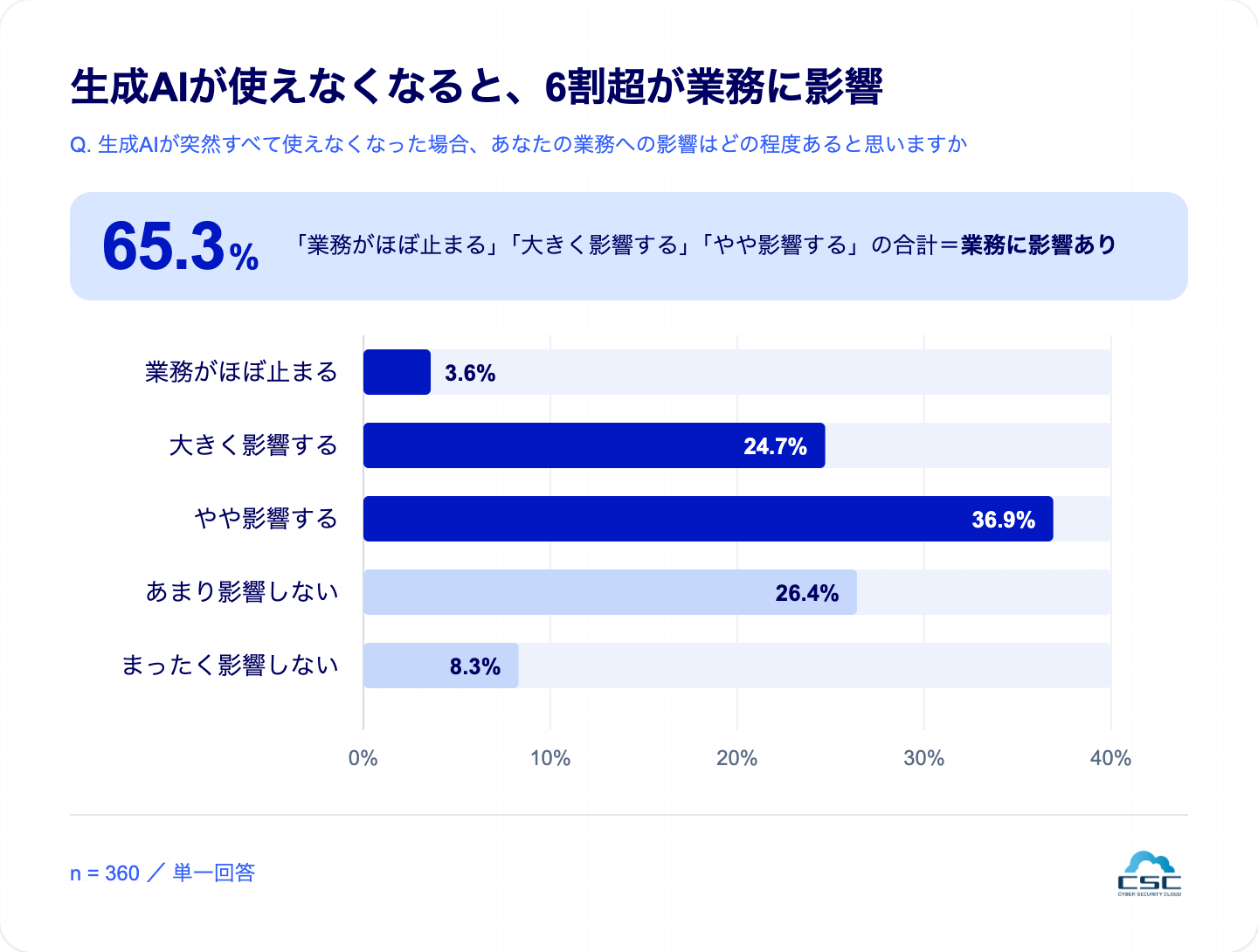
When 360 company employees who use AI generation in their work were asked about the impact of losing access to AI generation, 65.3% responded that it would affect their work.
A breakdown reveals that 3.6% reported "business operations almost completely halted," 24.7% reported "significant impact," and 36.9% reported "some impact." This clearly shows that for many users, generation AI is no longer just a "nice-to-have tool," but is becoming an "indispensable part of their work."
2. Over 40% of users are aware of their dependence on AI-generated content, and nearly half of those in their 20s use it daily.
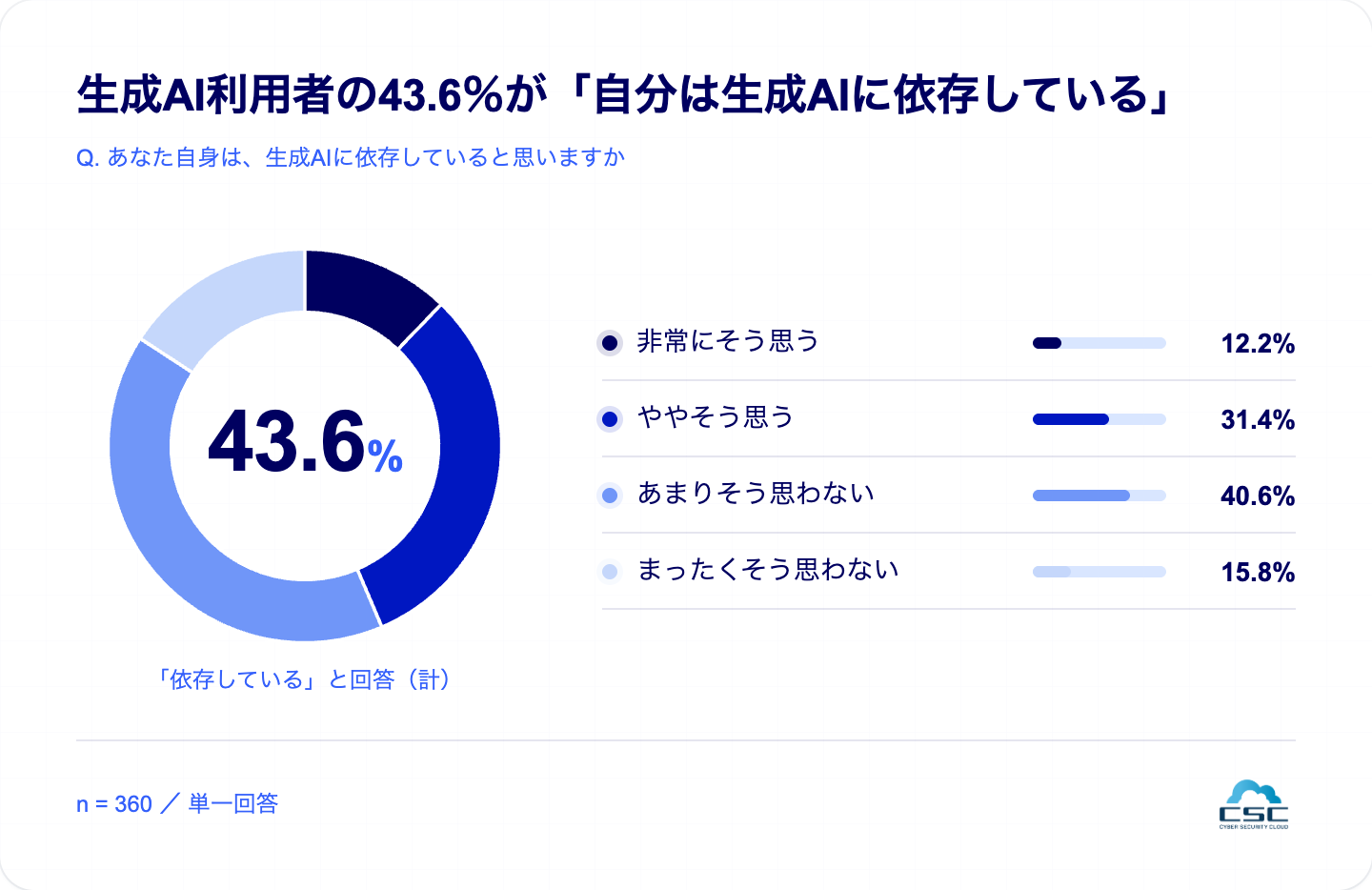
A survey on people's dependence on generating AI revealed that 12.2% "strongly agree" and 31.4% "somewhat agree," meaning 43.6% perceive themselves as dependent on AI. Looking at the results by age group, the highest level of AI dependence was among those in their 20s (50.5%), followed by those in their 30s (48.1%), 40s (40.6%), and 50s (38.7%), indicating a decreasing level of dependence with age.
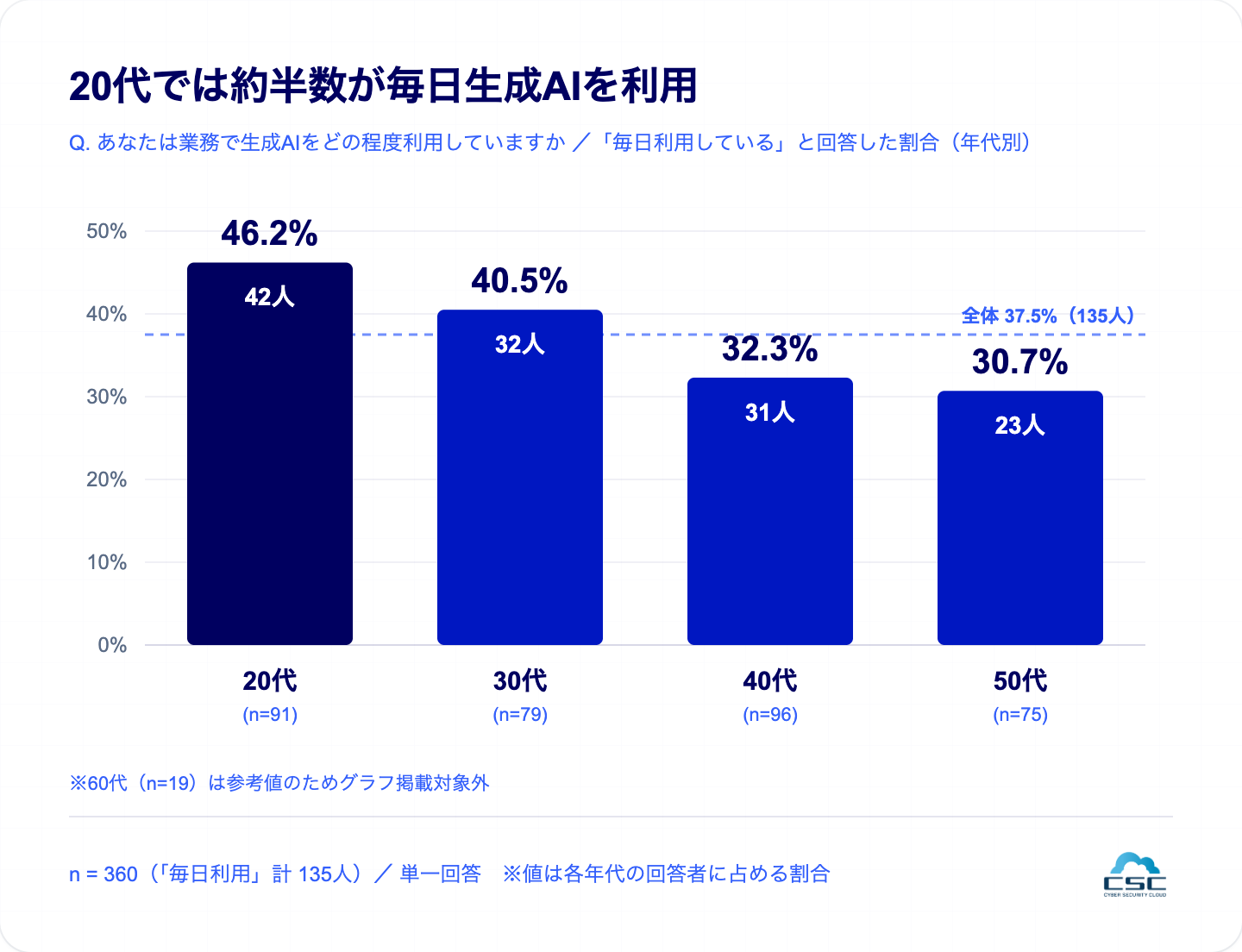
Regarding the frequency of use of generating AI, 46.2% of people in their 20s responded that they "use it every day," indicating that AI use has become commonplace, especially among younger employees.
3. Generating AI is evolving from a “search tool” to a “consultant,” with one in two people relying on AI more than their boss.
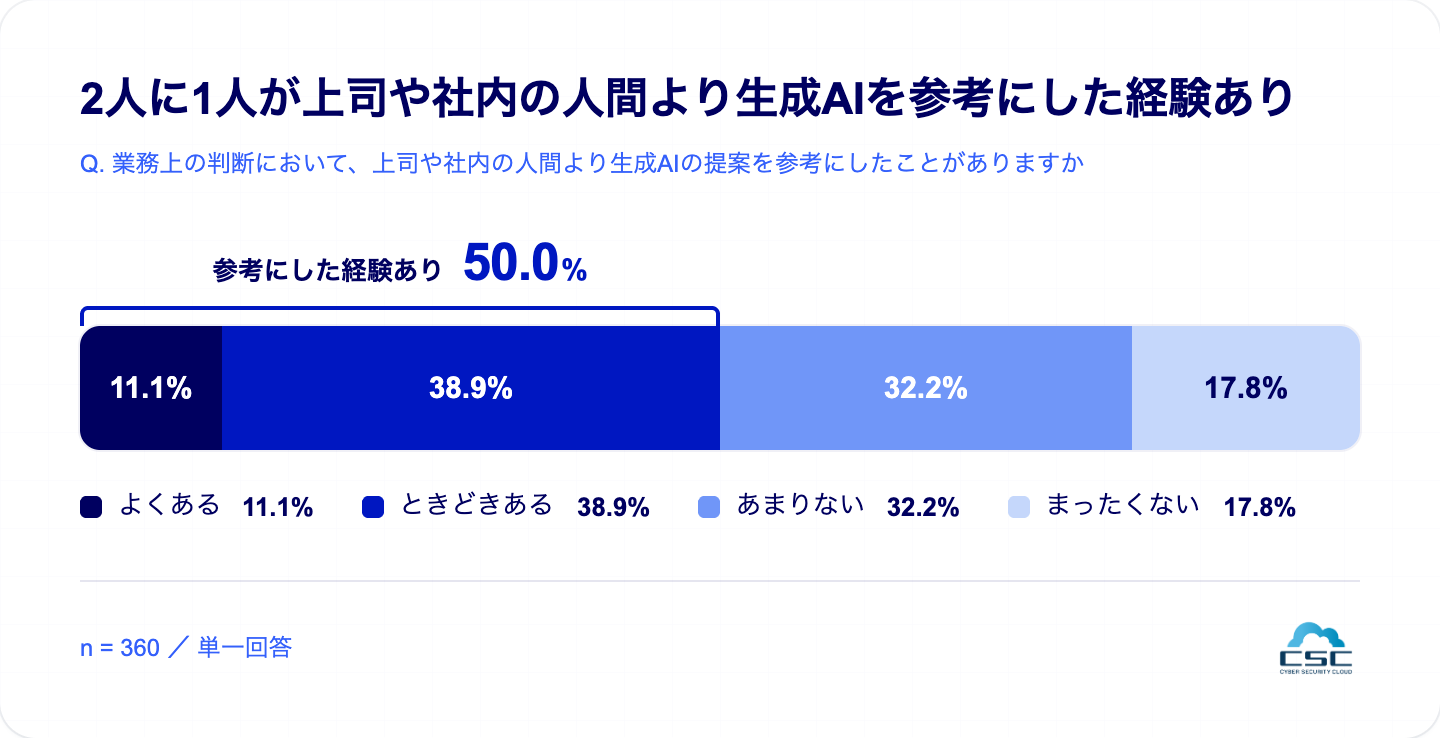
When asked whether they had ever referred to suggestions from a generation AI rather than those from their superiors or colleagues in their work decisions, 11.1% answered "often" and 38.9% answered "sometimes," indicating that a total of 50% had experience using generation AI as a criterion for decision-making.
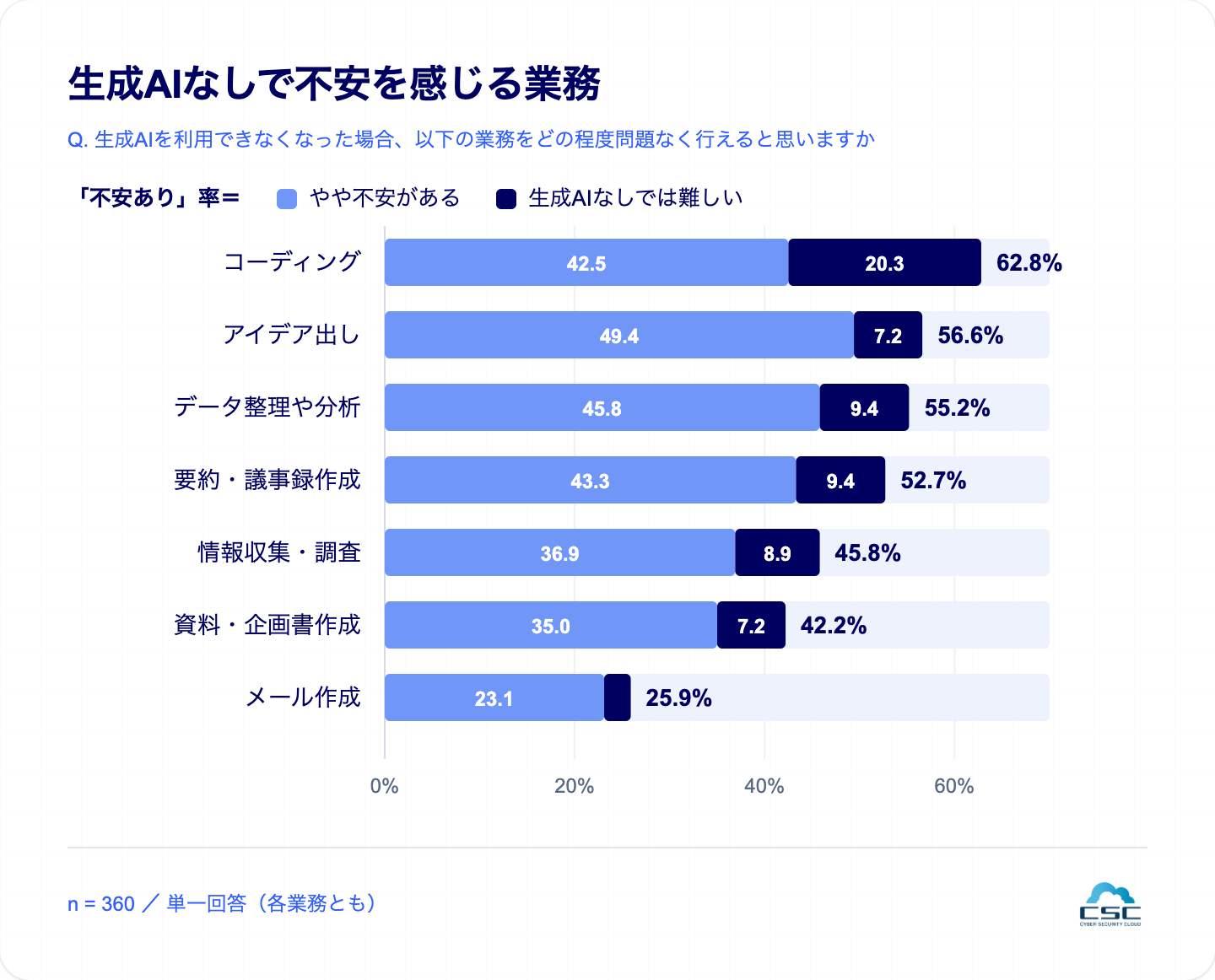
Generative AI is not only being used to improve the efficiency of tasks such as information retrieval and document creation, but is also beginning to permeate tasks that require expertise and intellectual productivity, such as planning, analysis, and coding.
Of the seven tasks surveyed, more than half of the respondents felt uneasy performing the tasks without generative AI in four of them. In particular, nearly 60% felt uneasy about coding (62.8%) and idea generation (56.6%), indicating that the use of generative AI is becoming a prerequisite for these tasks.
■Summary
This survey revealed that generative AI is not merely a tool for improving work efficiency, but is beginning to take root as an infrastructure that supports business operations.
65.3% of AI users responded that their work would be affected if they could no longer use generative AI, and 43.6% recognize themselves as being dependent on AI. Furthermore, half of them have referred to generative AI more than their superiors or colleagues, indicating that generative AI is evolving from a mere convenient tool into a partner that supports their work.
On the other hand, the expansion of AI utilization is also creating new challenges, such as the so-called "shadow AI problem," which involves AI usage that companies are unaware of and the associated risk of information leakage. As the use of AI in business operations becomes commonplace, it is urgent for companies to establish AI governance, including understanding the actual state of AI usage, developing usage regulations, and managing and controlling it.
*Shadow AI: When an employee uses a generator AI tool that has not been authorized or managed by the company for their work, based on their own judgment.
■ Survey Overview
Survey period: June 2nd - June 4th, 2026
Survey method: Internet survey
Survey conducted by: Cyber Security Cloud, Inc.
Survey commissioned to: Rakuten Insight, Inc.
Number of valid responses: 360
Survey subjects: Company employees who use AI generation in their work.